Bob Orchestrator: A NAB Show Award-Winning Workflow Platform
A BPMN workflow layer built on top of a live marketplace ecosystem, where onboarded services and API partnerships become executable business processes.
Published April 5, 2026
Bringing automation capabilities to existing systems is a known challenge.
Every integration is a custom project. Every new tenant requires its own configuration. A marketplace can handle forming alliances and partnerships between its users, but getting those users to go beyond raw API endpoints and build their own automated business logic on top of them is a different problem entirely.
That is the problem BoB Orchestrator was built to solve.
What Bob Does
Bob is a BPMN-based workflow automation platform that lives inside the BoB ecosystem. It lets tenants build, deploy, and monitor business processes, using their purchased API alliances as first-class workflow components alongside native BPMN elements.
The core idea is straightforward: if you have an active alliance with a payment provider, a notification service, or a data enrichment API, those services should show up in your workflow toolbox ready to use. No re-authentication, no manual wiring. The commercial agreement is already in place. Bob makes it executable.
The Modeling Experience
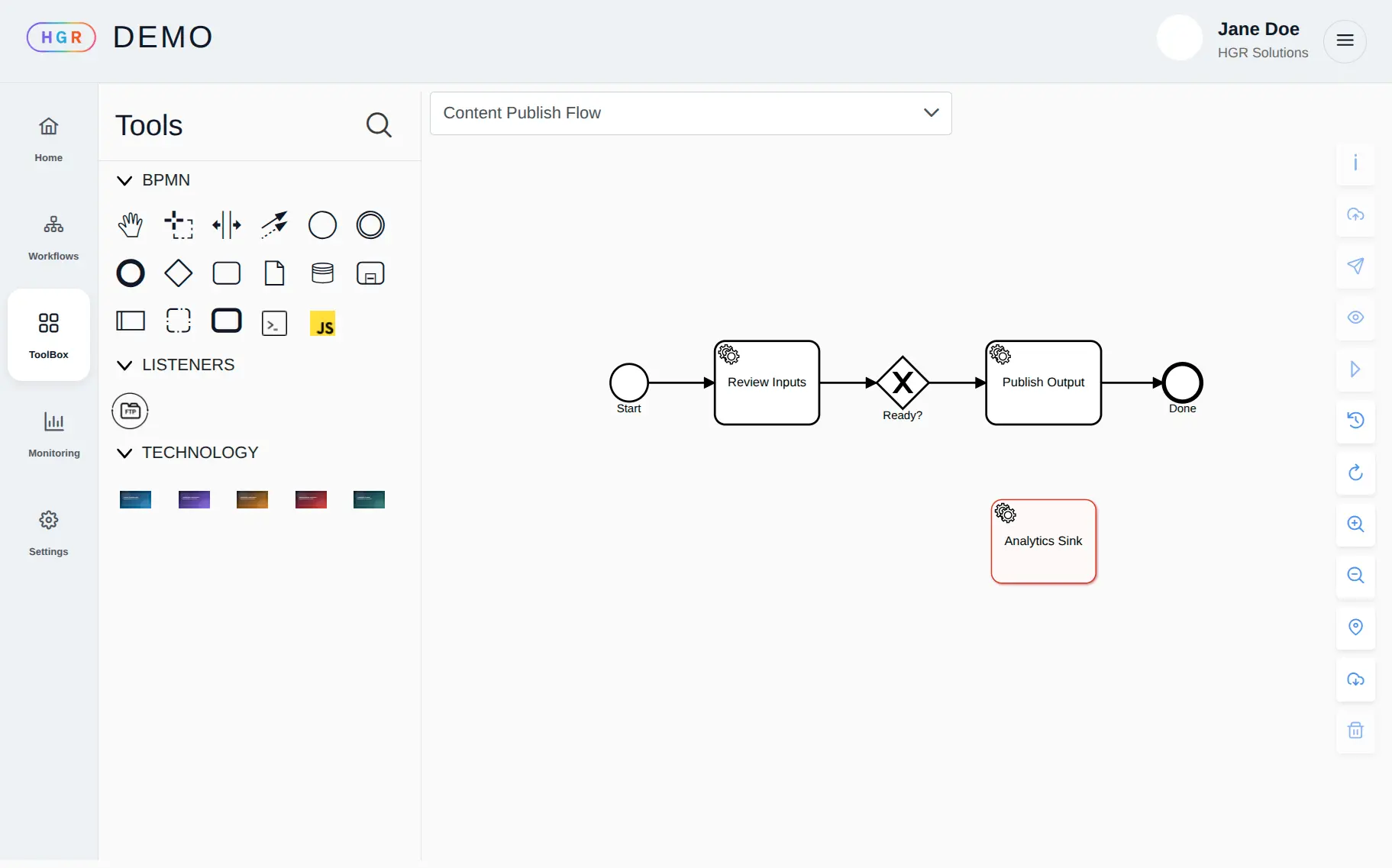
When a tenant opens the workflow editor, the ToolBox panel reflects their specific marketplace context. Standard BPMN elements sit alongside the tenant's purchased API alliances, rendered as drag-and-drop components with the same visual language. The modeler feels native. The toolbox is unique to each tenant.
The Challenge
Building a no-code workflow system that is genuinely powerful without becoming genuinely complicated is not a trivial design problem.
The goal was to put everything in one place without overwhelming the user.
A tenant working in the modeler needs to know what each service in their toolbox actually does, how to configure it as a task, and how to pass data from one task to the next. Three distinct problems that all need to feel like one seamless experience.
Each service exposed different inputs and outputs. The modeler had to surface that context inline, so users could understand and configure a service without leaving the canvas. Then came data flow: when a task produces an output, the next task needs to consume it. The solution was a global variable system built into the task panel. A user declares what a task returns, names it, and that variable becomes available as a selectable input anywhere downstream in the process. No code, no context switching.
The complexity lives in the system, not in the user's hands.
Monitoring
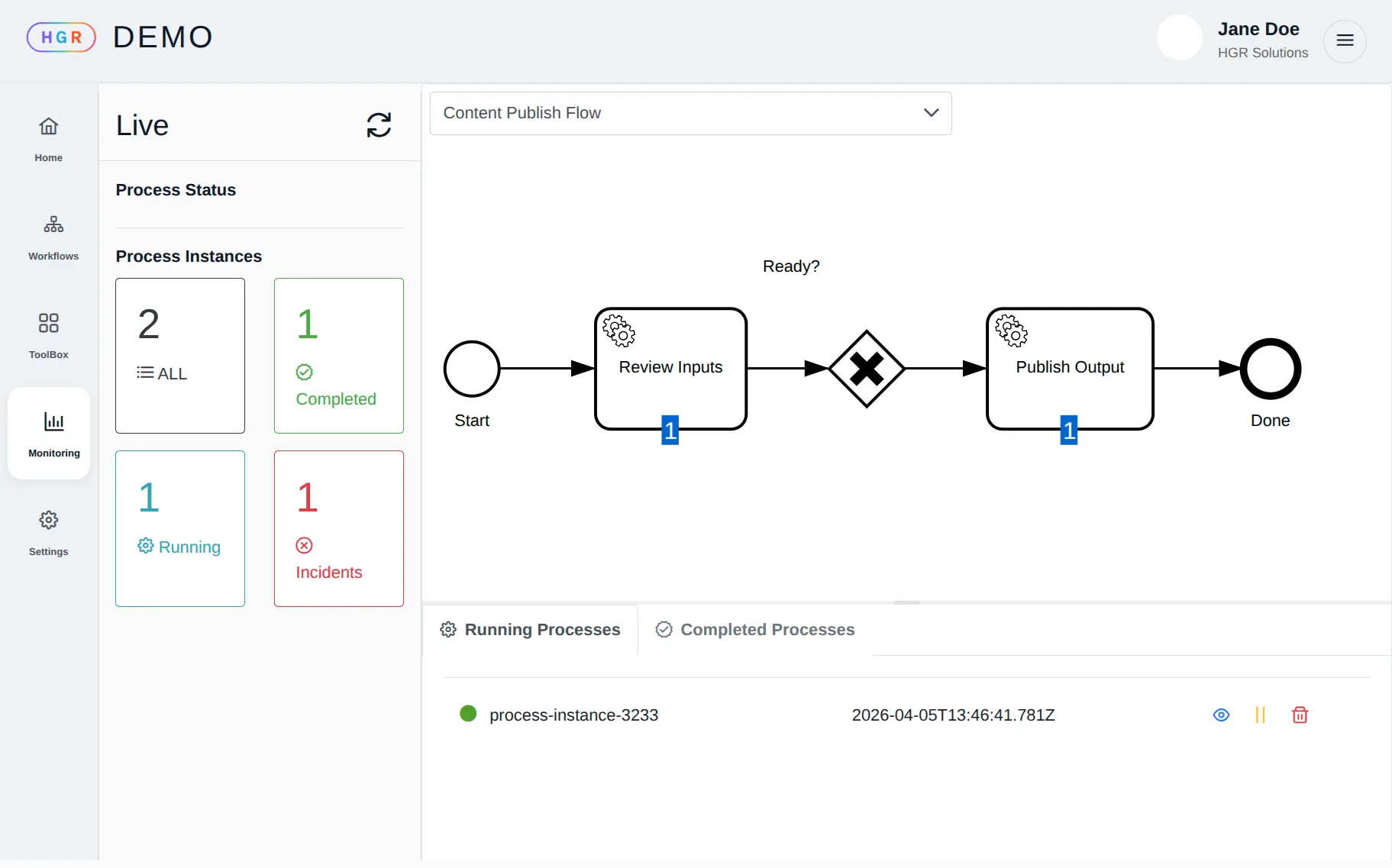
Every deployed workflow is tracked in real time. The monitoring view shows process instances grouped by status: running, completed, and incidents. The BPMN diagram updates live, with token counters on each element showing how many instances are currently at that step.
On a platform where every execution has a cost implication tied to an alliance agreement, operational visibility is not optional. Tenants know what is running, what completed, and what needs attention.
Result
Bob Orchestrator won Product of the Year at NAB Show 2023, one of the largest media and broadcast technology conferences globally.
More than the award, the project proved a specific idea: that a marketplace full of commercial API relationships becomes significantly more valuable when there is an execution layer on top of it. The alliances were already there. Bob made them actionable.
You can explore the demo at bob.hgr.agency, which walks through the full workflow lifecycle: modeling, toolbox configuration, variable management, deployment, and live monitoring.
Open calendar
Building or maintaining a workflow system?
If you’re dealing with workflow architecture, BPMN tooling, automation design, or the realities of running process systems in production, I help teams think through the hard parts clearly.
No pitch. Just a direct technical conversation.
Let's talk